
Ny på den här rutten? Färjeguide för Split till Hvar explains every option, operator and 2026 price in one place.
Where to stay on Hvar depends on what you want from your holiday. Hvar is a long island in Croatia. It is about one hour by boat from Split, the main city and port on the Dalmatian coast. Stay in Hvar stad if you want bars and restaurants within walking distance. Stay in Stari Grad för en lugnare, plattare gammal stad, precis där bilfärjan landar. Bo i Jelsa for family life and a real working harbour. Stay in Vrboska (a quiet canal village, sometimes called Hvar’s “little Venice”) for almost total peace. Stay in the Pakleniöarna (a small chain of islands just off Hvar Town) for a private spot you can only reach by boat. Or stay in Milna eller Sveta Nedjelja (two small beach villages on the south coast) for a quiet cove a few minutes from Hvar Town. We run transfers into every one of these harbours daily. The area you pick changes both your holiday and your transfer plan. So let’s go through them one by one.

Door-to-door travel time from Split to Jelsa (Hvar island)
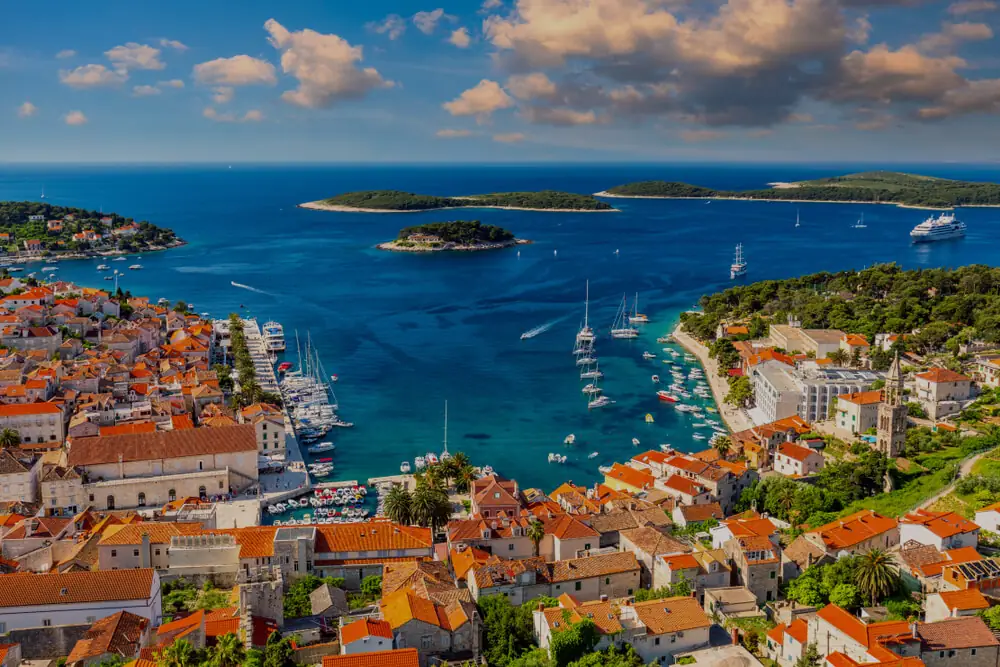
Hvar Town: glamour, nightlife and the easiest transfer
Innehållsförteckning
- 1 Hvar Town: glamour, nightlife and the easiest transfer
- 2 Stari Grad: den lugna, historiska basen – där bilfärjan landar
- 3 Jelsa: family life, wine country and a real waterfront
- 4 Vrboska: Hvar’s “little Venice” — the smallest and quietest
- 5 The Pakleni Islands: exclusive, remote, boat access only
- 6 Milna och Sveta Nedjelja: lugn sydkust, några minuter från Hvar Town
- 7 Boende på Hvar: jämförelse av områden
- 8 Split to Hvar: public transport or private boat?
- 9 How long to stay, and how to choose between areas
- 10 Väder, tider och en sak till innan du bokar
- 11 Vanliga frågor och svar
- 11.1 Var är det bästa området att bo på Hvar för ett första besök?
- 11.2 Är det bättre att bo i Hvar stad eller Stari Grad?
- 11.3 Var ska familjer bo på Hvar?
- 11.4 Kan man övernatta på Pakleniöarna?
- 11.5 Hur tar man sig från Split till Hvar utan att först gå igenom Hvar stad?
- 11.6 Är Vrboska värt att bo i om jag vill ha lugn och ro?
- 11.7 Vilken hamn anländer färjan från Split egentligen till?
- 11.8 Hur många dagar bör jag tillbringa på Hvar?
- 12 Källor och vidare läsning
Hvar Town is the main town on the island. It has a fortress on the hill, a big square built in the Venetian style, and a harbour full of yachts by August. It also has the most bars and boutique hotels on the island. It suits first-time visitors and anyone who wants to step off a boat and be in the middle of everything. Good to know: the town renewed its noise rules for 2026. Outdoor music on summer evenings is now capped at about the level of a busy restaurant. So the old “party island” image has calmed down, and families now come here too. You can find almost every type of accommodation here. But most of it sits up stone steps, with no lift and no road access. Bring a small suitcase.
Skepparens tips: if your accommodation is in the Old Town, no transfer can drop you at the door. You will pull your suitcase over the stone streets for the last part. A private boat at least lands you at the town quay itself. That is usually closer to Old Town addresses than the public catamaran berth at the far end of the harbour.
Att ta sig dit: the passenger catamaran (Jadrolinija line 641, and Krilo / Kapetan Luka) sails straight into Hvar Town harbour in 50–60 minutes. In peak season there are up to 18–20 sailings a day. Tickets cost about €10–30 per person, one way; most summer tickets cost €18–25. The last boat back is usually around 20:00. Our privat taxibåt från Split till Hvar takes about 55 minutes to the town quay, at any time you choose. Flying in? Our Transfer från Split flygplats till Hvar skips the city. You can be on the water within an hour of landing.
Stari Grad: den lugna, historiska basen – där bilfärjan landar
Stari Grad is the oldest town on the island, on the north coast. It has flat streets, a waterfront shaded by pine trees, and lavender fields inland. Life here is slower than in Hvar Town. The flat layout suits families and anyone who does not want to climb steps to their room. It is also where the car ferry from Split actually docks. This surprises many first-time visitors. Cannot decide between these two towns? You do not have to. They are only a 20-minute drive apart. Read our full comparison, Stari Grad eller Hvar stad.
Att ta sig dit: the Jadrolinija car ferry (line 635) takes about 2 hours. It is the only public option that carries cars. In high season (late May to late September) an adult ticket costs €8.40 and a standard car costs €47.60, so about €56 together. In low season tickets are a little cheaper. Book ahead in summer, because your ticket is also your car’s reservation. From the port it is about 20 km (20–35 minutes) by road to Hvar Town. A private boat lands directly in Stari Grad in around 55 minutes from Split.
Jelsa: family life, wine country and a real waterfront
Jelsa is a small harbour town on the north coast, east of Stari Grad. Many people who have already seen Hvar Town choose Jelsa on their second visit. It is a real working harbour with a farmers’ market and an open-air cinema. The waterfront has konobas (small local restaurants), ice-cream bars and a popular playground. In summer there is a kids’ “mini disco” twice a week. The sea here is shallow and calm, so it is one of the most family-friendly places on Hvar. Jelsa sits in Hvar’s wine country. Apartments here usually cost clearly less than the same standard in Hvar Town.
Att ta sig dit: no direct ferry goes to Jelsa. With public transport you land in Hvar Town or Stari Grad and continue by bus. The bus takes 35–40 minutes from Hvar Town, or 15 minutes from Stari Grad. Ferry plus bus usually takes 2.5–3 hours door to door. A private boat lands directly in Jelsa’s harbour in one trip. More in Split till Jelsa 2026.
Vrboska: Hvar’s “little Venice” — the smallest and quietest
Vrboska is the area most first-time visitors have never heard of. That is exactly why people choose it. It is a tiny village on a long, narrow inlet that looks like a fjord. A canal runs through it, crossed by small stone bridges. There is a fortress church from the 16th century and almost no nightlife. Soline beach is a short walk away. Next to the village is the Stari Grad Plain, an ancient field system on the UNESCO World Heritage list. Pick Vrboska if you want to fully switch off. Skip it if you want a choice of restaurants within walking distance every night. Att ta sig dit: no ferry serves Vrboska directly. Go via Stari Grad (car ferry, then about 10 minutes by road) or via Hvar Town (catamaran, then 30–40 minutes by road). A private transfer lands right in Vrboska’s canal harbour. Full details in our Vrboska Hvar-guide för 2026.
The Pakleni Islands: exclusive, remote, boat access only
The Pakleni Islands sit just across the water from Hvar Town harbour. They are a chain of small islands covered in pine trees. The main ones are Sveti Klement, Jerolim and Marinkovac. They are Hvar’s most exclusive place to sleep, for a simple reason: you cannot drive there. On Sveti Klement, the Meneghello family has run villas at Palmižana bay for decades. You sleep in bungalows set in botanical gardens, next to a well-known seafood restaurant. You can only get there by water taxi or private boat. Other private villas on the islands suit couples or small groups who want privacy, with Hvar Town’s lights in view. Day-trip boats fill the beach bays from about 11:00 to 17:00. If you stay overnight, you get the islands to yourself after the last excursion boat leaves. Att ta sig dit: no public ferry goes there directly. The usual route is the catamaran to Hvar Town, then a local water taxi, which depends on weather and timetables. A private transfer goes straight from Split to a Pakleni dock in one trip of about 55 minutes. That saves you the change of boats. Full guide: Pakleni Islands guide för 2026.
Skepparens tips: Vrboska and the quiet Pakleni bays are best in the shoulder season — May, June or September. Even these calm places get emptier then. And you will not share Soline beach with half of Jelsa’s day-trippers.
Milna och Sveta Nedjelja: lugn sydkust, några minuter från Hvar Town
Do you want a quiet beach, but still close to Hvar Town’s restaurants? Look at the south coast, at Milna and Sveta Nedjelja. Milna is a small village in a sheltered cove about 4 km from Hvar Town. It is close enough for a taxi into town for dinner, but far enough to avoid the day-trip crowds. It has four sunny beaches. Almost all accommodation is in private apartments. Sveta Nedjelja is further along the coast, below the island’s highest peak. It feels like a village where people live, and it has no hotels at all. Neither place has a ferry connection. A private boat drops you at a jetty in either village in one trip from Split. For more swimming spots, see our guide to Hvars stränder med båt.
Boende på Hvar: jämförelse av områden
Here is the full picture side by side: the feel of each area, who it suits, and how long it takes from Split by public transport or by private boat.
| Område | Feel | Bäst för | Ta sig dit från Split (offentlig/privat) |
|---|---|---|---|
| Hvar stad | Glamour, restaurants, nightlife (now with noise limits) | First-time visitors, couples, nightlife | Catamaran 50–60 min direct / private boat about 55 min direct |
| Stari Grad | Lugn, historisk, platt gammal stad | History lovers, families, people with a car | Car ferry about 2 h (the ferry port) / private boat about 55 min direct |
| Jelsa | Familjevänligt vinland, riktig strandpromenad | Families, lower budgets | Ferry or catamaran + bus, 2.5–3 h in total / private boat direct, about 55 min |
| Vrboska | Tyst kanalby, "lilla Venedig" | Couples who want total quiet | Ferry or catamaran + short drive (about 10 min from Stari Grad) / private boat direct |
| Pakleniöarna | Exclusive, remote, boat access only | Privacy, honeymoons, small groups | Catamaran + local water taxi / private boat direct, about 55 min |
| Milna / Sveta Nedjelja | Lugna vikar på sydkusten nära all action | Strandboende nära Hvar stad | Katamaran till Hvar stad + kort taxi / privat båt direkt |
Split to Hvar: public transport or private boat?
Whichever area you choose, you first need to cross from Split. Here are the three options compared.
| Alternativ | Tid från Split | När den körs | Pris (2026) | Good to know |
|---|---|---|---|---|
| Passenger catamaran (Jadrolinija, Krilo, TP Line) | 50–60 min to Hvar Town, then 15–40 min by bus or taxi to other areas | Fixed timetable; up to 18–20 sailings a day in July–August, far fewer in winter | About €10–30 per person, one way | Foot passengers only. Often cancelled in strong wind. Last boat back around 20:00. |
| Car ferry (Jadrolinija) | About 2 h to Stari Grad, then 20–35 min by road to Hvar Town | Several sailings a day, all year | €8.40 per adult + €47.60 per car in high season | Takes cars. Handles bad weather best. Lands 20 km from Hvar Town. |
| Privat taxibåt (Dalmatia Express) | About 55 min, direct to Hvar Town, Stari Grad, Jelsa, Vrboska, Milna or the Pakleni Islands | 24/7, on your schedule | €370–900 per boat (not per person) | Door-to-door to your harbour. Sails when catamarans cancel (closed cabin, radar). Split Airport pickup available (€400–900 per boat). Fair price for groups of 4–10. |
A private boat costs more than two catamaran tickets. But the price is per boat, so a family or a group of 4–10 shares it. You also skip the bus or taxi ride on the island. See prices and book on our Taxibåtssida för Split till Hvar.
How long to stay, and how to choose between areas
Three nights suits most first-time visitors: Hvar Town itself, an afternoon in the Pakleni Islands, and one more stop. With five nights the island really opens up. You have time to add Stari Grad or Jelsa as a second base. Do not try to see every area on day trips from one base. Hvar’s roads are narrower and slower than the map suggests. Bus timetables rarely match a holiday schedule. Two bases usually work better than one base and many day trips. Still deciding? Send us your dates and group size via vår kontaktsida. We sail to every one of these harbours daily. We can tell you honestly what a direct transfer would cost your group, not per person.
Väder, tider och en sak till innan du bokar
High season (late June to August) brings warm sea and the highest prices. Book Hvar Town waterfront accommodation four to six months ahead. The shoulder season (May, June, September) is the best time for Stari Grad, Jelsa and especially Vrboska. Prices drop and the towns get even quieter. Watch the wind in every season. The bura (a strong, cold wind from the north-east) and the jugo (a warm, wet wind from the south-east) are the first to cancel the fast public catamarans. The car ferry copes better. Our closed-cabin boats with radar can often still sail when the timetabled boats stay in port. Arriving on an early or late flight? Check the current catamaran timetable instead of guessing. Sailings drop off outside peak season. A private airport transfer runs on your flight time instead. Whatever you decide, contact us via vår kontaktsida with your dates before you book your accommodation.
Se ön Hvar innan du åker
Vanliga frågor och svar
Var är det bästa området att bo på Hvar för ett första besök?
Hvar Town, for most people. Restaurants, the harbour and boat trips to the Pakleni Islands are all within walking distance. It is also the easiest area to reach, both by public catamaran and by private boat.
Är det bättre att bo i Hvar stad eller Stari Grad?
Hvar Town suits nightlife and a central location. Stari Grad suits a calmer pace, a flat old town, and anyone arriving by car ferry, because the ferry docks there. They are only 20 minutes apart by road, so many visitors split their stay between both.
Var ska familjer bo på Hvar?
Jelsa and Stari Grad are the two most recommended family bases. Jelsa has a waterfront playground and family events. Stari Grad has a flat old town. Milna’s calm coves are also a good option close to Hvar Town.
Kan man övernatta på Pakleniöarna?
Yes. Accommodation is limited to villas and a few small boutique properties, such as the Meneghello villas at Palmižana on Sveti Klement. There is no road and no ferry, so you can only arrive by water taxi or private boat.
Hur tar man sig från Split till Hvar utan att först gå igenom Hvar stad?
A private boat is the only direct option to areas like Jelsa, Vrboska, Milna or the Pakleni Islands. Public transport always lands at one of the two ferry ports, Hvar Town or Stari Grad, and you connect from there.
Är Vrboska värt att bo i om jag vill ha lugn och ro?
Yes, more than almost anywhere on the island. It is the smallest and quietest of Hvar’s towns, with a single canal and almost no nightlife. It suits couples who want to disconnect. It is a poor choice if you want many restaurants within walking distance.
Vilken hamn anländer färjan från Split egentligen till?
It depends on the service. The fast catamaran lands directly in Hvar Town harbour. The car ferry lands about 20 km away in Stari Grad, so you need a bus, taxi or car to reach Hvar Town. Neither stops at Jelsa, Vrboska, Milna or the Pakleni Islands.
Hur många dagar bör jag tillbringa på Hvar?
Three nights is a reasonable minimum. Five nights is ideal if you want to add a second base. If you are short on time, pick two areas and split your stay. That works better than day trips everywhere from one base.

Between Hvar Town and Stari Grad lies Velo Grablje, an old lavender village in the hills. It holds a small Lavender Festival every June. It makes an easy half-day trip from any base.
Looking for a luxury stay? Two names stand out. Palace Elisabeth is the historic hotel on Hvar Town’s main square. Maslina Resort, near Stari Grad, is a five-star Relais & Châteaux hotel with its own quiet bay.
Wherever you stay, three practical tips: eat at Dalmatino or Giaxa, two well-known restaurants in Hvar Town; rent a car or scooter from Luka Rent; and book a paddling day with Kajak & SUP Hvar.
When people talk about Hvar nightlife, they usually mean three places: Hula Hula, a beach bar for sunset drinks; Kiva Bar, in a back lane, for the late crowd; and Carpe Diem, a beach club across the water on the Pakleni Islands.
Källor och vidare läsning
- Jadrolinija – Split–Hvar ruttinformation
- Besök Hvar (officiell turistbyrå) — Hur man tar sig till Hvar
- Besök Jelsa (officiell turistbyrå) — Hur man tar sig till Jelsa
- Hvar-info — Färjor till Hvar, tidtabeller och rutter
 Swedish
  English
  Croatian
  Spanish
  French
  Russian
  German
  Italian
  Portuguese
  Arabic
  Norwegian
  Finnish
  Chinese
  Polish
  Dutch
Dutch